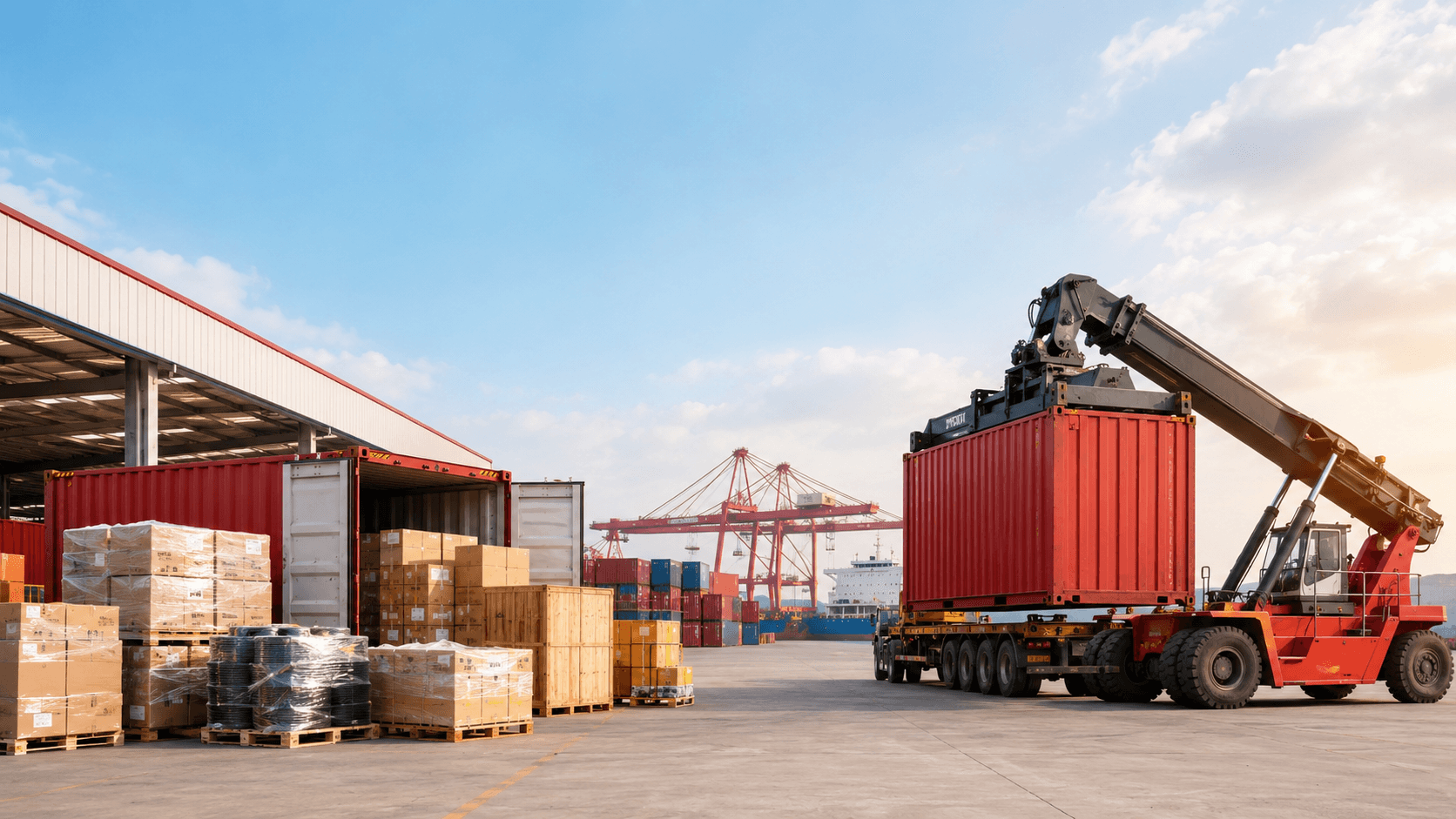
At some point, every China importer faces this question. Your order is ready to ship — do you put it on a vessel or an aircraft?
The gut answer most people give is: "sea is cheaper, air is faster." That's true as a starting point. But the real decision is more nuanced — because the right answer depends on your cargo type, your business model, and how you calculate cost.
Here's the full comparison.
The Core Difference
Sea freight moves your cargo in a container aboard a vessel. It's slow (5–25 days depending on the origin-destination pair), but the cost per kilogram is a fraction of air.
Air freight moves cargo in the belly hold of a commercial aircraft or on a dedicated freighter. It's fast (2–5 days door-to-door), but cost per kilogram is 4–8x higher than sea.
That ratio — 4–8x — sounds simple. But it doesn't capture the full picture.
Full Cost Comparison: China to Philippines Example
Let's use a real scenario. You're importing 500 kg / 2 CBM of industrial components from Guangzhou to Manila.
Sea Freight (LCL)
Component Estimated Cost
Ocean freight (2 CBM × $40) $80
Origin CFS & documentation $100
Destination handling & deconsolidation $90
Customs broker fee $120
Last-mile trucking $70
**Subtotal** **~$460**
Transit time 14–20 days (inc. consolidation)
**Cost per kg** **~$0.92/kg**
Air Freight
Component & Estimated Cost
Air freight (500 kg × $4.50/kg) $2,250
Origin handling & documentation $80
Airport handling at NAIA $60
Customs clearance $120
Last-mile delivery $70
**Subtotal** **~$2,580**
Transit time 3–5 days door-to-door
**Cost per kg** **~$5.16/kg**
Difference: $2,120 more for air on this single shipment. That's real money. But whether that difference is worth it depends entirely on what $2,120 buys you — specifically, the 10–15 days of additional lead time you get from sea vs air.
When Air Freight Makes Financial Sense
Air freight earns its premium when the cost of delay exceeds the cost of the air freight surcharge.
Scenario A: Machine downtime. You operate a construction fleet in Davao. One excavator is down waiting for a hydraulic pump. Every idle day costs you PHP 80,000–150,000 in lost productivity and equipment hire costs. A USD $400 air freight bill for the pump is trivially cheap compared to even one day of downtime.
Scenario B: Seasonal inventory. You import electronics or consumer goods for peak season (Christmas, back-to-school). You missed your sea freight cut-off. Arriving two weeks late means missing the sales window entirely. The margin hit from air freight is smaller than the margin loss from missed sales.
Scenario C: High value, low weight. You're importing precision instruments, semiconductor components, or medical devices. The cargo weighs 30 kg and is worth USD $15,000. Air freight cost: USD $180. Sea freight cost: USD $80. For a USD $15,000 cargo, paying an extra USD $100 for faster, more secure transit is an easy call.
Scenario D: Samples and product testing. You're testing a new product line before placing a bulk order. Getting 20 samples by air in 3 days vs. sea in 20 days compresses your product development cycle significantly.
When Sea Freight Is the Right Call
Regular bulk orders. If you're importing 500 CBM of goods per month — furniture, apparel, construction materials, general merchandise — sea freight is the only economically viable option. Air freight at that volume would be commercially absurd.
Non-urgent stock replenishment. If you plan your inventory with 30+ days of buffer, the extra 15 days of sea transit is absorbed without disruption.
Heavy, low-value-density goods. Steel pipes, ceramic tiles, concrete additives, machinery frames. These goods are heavy relative to their value. The air freight cost per kilogram quickly exceeds the value per kilogram.
Full container loads (FCL). At FCL volumes (15+ CBM or 5+ tonnes), sea freight is almost always the answer. Air freight at those volumes becomes prohibitively expensive for any normal commercial cargo.
The Hybrid Approach: What Experienced Importers Do
Most mature import operations use both modes strategically:
• Sea freight for regular stock orders — Planned in advance, lead time absorbed in inventory buffer
• Air freight for emergency replenishment — When a fast-moving item stockouts unexpectedly
• Air freight for new product launches — First production run arrives by air, follow-on bulk orders by sea
• Air freight for high-margin, compact goods — Where the freight cost is a small percentage of selling price
The goal isn't to choose one mode and stick to it — it's to match the mode to the business need.
Air Freight to Philippines: Port-Specific Notes
Manila (NAIA)
The main air freight hub. All major carriers (Cathay Cargo, China Airlines Cargo, Emirates SkyCargo, FedEx) have regular freighter operations or belly capacity through NAIA. Most China-origin air cargo arrives in Manila within 2–3 calendar days.
Cebu (MCIA — Mactan-Cebu International Airport)
Direct China-Cebu air freight capacity is more limited. Most freight routes via Manila for transhipment. For importers in Cebu, this adds 1–2 days versus Manila-cleared cargo. For time-critical shipments, some importers clear through Manila and arrange domestic air forwarding to Cebu.
Davao (Francisco Bangoy International Airport)
Limited international freighter capacity. Most air freight transits Manila. For Davao-based importers, DDP air shipments to Manila + domestic forwarding is the most common arrangement. Alternatively, for very urgent cargo, clearing in Manila and trucking to Davao (18–24 hours) is possible.
China to Malaysia: Sea and Air Comparison
For Malaysian importers — primarily clearing through Port Klang (North Port and West Port) or Penang Port:
Sea freight transit:
• Guangzhou/Shenzhen → Port Klang: 5–7 days
• Shanghai → Port Klang: 9–12 days
Air freight transit:
• China → KLIA: 2–3 days door-to-door
Malaysian customs (Royal Customs / JKDM) is generally faster than BOC Philippines — green channel clearance in 1–2 days is common for compliant importers.
Get the Right Quote for Your Shipment
Ship Nanyang handles both sea and air freight from China to the Philippines, Malaysia, and across Southeast Asia. Tell us your cargo details — weight, volume, origin, destination, timeline — and we'll give you both options with honest guidance on which one makes sense for your situation.
Request a freight quote →
*Ship Nanyang — China freight forwarding specialists serving the Philippines, Malaysia, UAE, and the USA.*

Forget the hassle of international shipping—order from China with ease, and we'll handle the rest.


Contact

+852 6091 1394

Hong Kong Head Office
RX Nanyang Ltd
Room 1601, 16/F Workington Tower
78 Bonham Strand, Sheung Wan,
Hong Kong
Branches
Philippines, Manila
26th & 27th Floors The Podium
Ortigas Center, Mandaluyong
+63 966 401 6784
Malaysia, Kuala Lumpur
Suite 9-08, 9th Floor
Wisma Warisan, 33 Jalan Yap Ah Shak
50300 Kuala Lumpur
© 2026 RX Nanyang Ltd. All rights reserved.
Forget the hassle of international shipping—order from China with ease, and we'll handle the rest.
Contact
+852 6091 1394
Hong Kong Head Office
RX Nanyang Ltd
Room 1601, 16/F Workington Tower
78 Bonham Strand, Sheung Wan,
Hong Kong
Branches
Philippines, Manila
26th & 27th Floors The Podium
Ortigas Center, Mandaluyong
+63 966 401 6784
Malaysia, Kuala Lumpur
Suite 9-08, 9th Floor
Wisma Warisan, 33 Jalan Yap Ah Shak
50300 Kuala Lumpur
© 2026 RX Nanyang Ltd. All rights reserved.